
If I were to rank the questions I get asked by teachers most frequently, reading logs would be right at the top of the list. The topic of reading logs brings up strong opinions, both from teachers and parents. Educators whom I greatly admire have written posts questioning the authenticity of reading logs, rethinking reading logs as an at home assignment and alternatives to using a reading log. I agree with all they and others have written on this topic. I've used many of the ideas they mention in my own teaching practice. But before we "throw the baby out with the bath water", I would like to offer another perspective that I've been "writing" in the air of my thinking and conversations with others over the past few months.
When I first started teaching fourth grade, I used a reading log for keeping students accountable for reading both inside and outside of school. Parents were asked to sign an at-home reading log to verify that their student actually did the reading. I even gave points that counted toward a reading grade. I cringe even as I type this! What I came to realize was that the voracious readers hated them. The striving readers didn’t fill them out. Parents signed them, often times on Friday morning while sitting in the drop off line. A parent signature didn’t always mean that the reading actually happened. I was always chasing the missing logs. But the thing I realized most was that I was sending a very unintended message that reading was a school job.
As my understanding of best practice deepened and evolved, I reflected on this practice that, while well intended, was doing more harm than good. Readers who read for pleasure rarely, if ever, keep a daily, detailed account of their reading. Taking time to keep track of minutes or pages read did not encourage reading for enjoyment, nor was it improving reading skills. Rather, the opposite was happening. Reading was being viewed as a “chore”, something that was a school “job” and was devoid of enjoyment.
I knew that:
I knew that:
- To become a reader, you have to actually devote time to reading. I believe that it’s important that time for independent reading be provided both at school and at home.
- The most reliable data I could collect in regards to stamina, fluency, and reading growth was that which I could document while students were in school.
- The single greatest factor in reading achievement is reading volume (Krashen, 2004) so I needed to have some formative way of documenting students’ reading volume.
- When implemented as a way to ensure that students were reading at home, the mandatory, at-home reading log was not bringing the benefit initially expected.
I stopped using an at-home reading log, instead focusing on the reading time I could control at school. Students still kept a record of the books they read during the school year, but rather than minutes and pages, they kept track of title, author, genre, start/end date, and a simple rating. The shift that made the most impact in the value of the record was that I devoted time for students to reflect on their reading record, guiding them to notice how they were growing as a reader, and helping them set goals that expand their reading repertoire. During small group work and conferring I would guide students to identify patterns in genres, formats, and authors they had read to help them see how they were expanding their reading lives. By always referring to them, students came to value them, keep them up to date, and use them for goal setting, pushing themselves to outgrow their selves as readers.
In my role as a Literacy Strategist, my teachers have been grappling with the same questions and struggles in regard to the dreaded reading log. As I’ve talked about my own experience over the past few years, I’ve come to understand that what made the shift for me was my reflection on the purpose of asking readers to record what they were reading. These conversations brought me to the realization that there are actually two different ways of asking students to keep track of their reading, but each serves a different purpose.
log (n)
an official, systematic documentation of an event, such as ship’s journey, or a diet plan kept for intervals of time
record (n)
a list of items or events, written down over long periods of time, as a way to preserve for later reference/reflection
A reading log could be used in 1 to 2 week intervals at various points throughout the trimester for the purpose of assessing reading stamina. You might also consider a reading log at the beginning of a non-fiction unit of study, when stamina and volume are likely to decrease. The reading log allows for student reflection, analysis and goal setting. These logs would include students documenting pages & minutes read each day.
Date
|
Title
(Write whole title once per sheet, then abbreviate title to one word until book is complete or your start a new sheet)
|
Start Time
|
End Time
|
Total Minutes
|
Number of Pages
|
Example provided by Molly Leding
A reading record would be used from the beginning of the school year (or beginning of new reading unit) for the purpose of documenting the books a student reads over the school year (or unit of study). A reading record is used for student reflection of authors and genres read, goal setting, and to assess volume. The reading record would include title, author, genre, rating scale, and date finished.
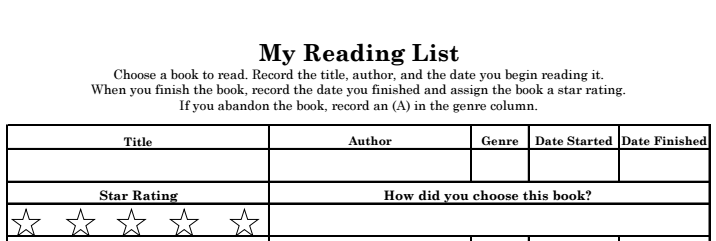 |
| From Reading in the Wild by Donalyn Miller |
Will you still need to remind students to keep their reading log or reading record up date? My first response is “Yes, you probably will.” But my second response is a question. You wouldn’t stop reminding a child to brush their teeth or wash their hands or any of another 1,000,000 things we remind children to do on daily simply because they have yet to “see the value” in doing those things, would you? I believe there is value to using these tools in the classroom. There are certainly digital options available for recording one's reading history. I have used them. But I would argue that those options are only viable if all students are provided access to them at school.
When we keep "purpose" in mind, and use the things we are asking children to do in authentic ways, they will engage. The key to these particular tools becoming useful to readers is that they are referred to consistently, both by the teacher and with the student, as a tool for reflection and goal setting.
When we keep "purpose" in mind, and use the things we are asking children to do in authentic ways, they will engage. The key to these particular tools becoming useful to readers is that they are referred to consistently, both by the teacher and with the student, as a tool for reflection and goal setting.


 Posts
Posts

